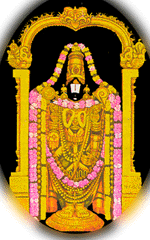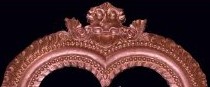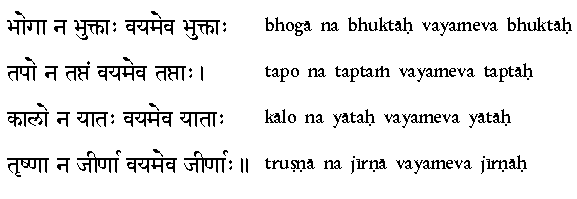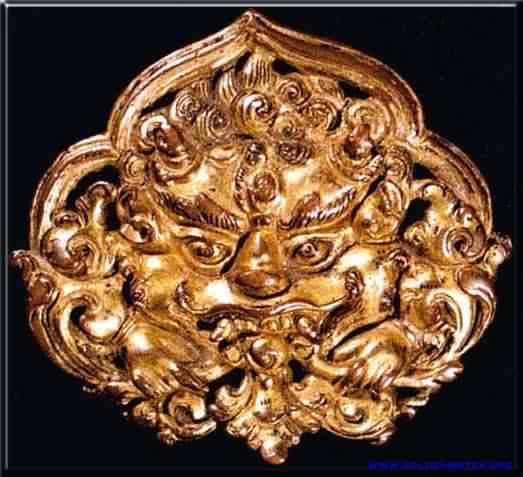

Māyā is the veiling of the true, unitary Self. The Kirtimukha mask, similarly hiding Reality, is present in all of us. Spiritual aspirants are reminded of this stark reality and warned about its hidden power by the Kirtimukha image present everywhere in Hindu temples - in the gopurams, on the ramparts and even in the prabhai (arch) above the idol in the garbha-griha (sanctum sanctorium).In his book "Myths to Live By", Joseph Campbell narrates the story about Kirtimukha from Hindu mythology (Siva Puranam), that is highly symbolic of the self-destructive nature of the unbridled ego-self in us."Let me recount now a really marvelous Hindu legend to this point, from the infinitely rich mythology of the god Shiva and his glorious world-goddess Parvati. The occasion was of a time when there came before this great divinity an audacious demon who had just overthrown the ruling gods of the world and now came to confront the highest of all with a non-negotiable demand, namely, that the god should hand over his goddess to the demon. Well, what Shiva did in reply was simply to open that mystic third eye in the middle of his forehead, and puff! a lightning bolt hit the earth, and there was suddenly there a second demon, even larger than the first. He was a great lean thing with a lion-like head, hair waving to the quarters of the world, and his nature was sheer hunger. He had been brought into being to eat up the first, and was clearly fit to do so. The first thought: "So what do I do now?" and with a very fortunate decision threw himself upon Shiva's mercy.Now it is a well-known theological rule that when you throw yourself on a god's mercy the god cannot refuse to protect you; and so Shiva had now to guard and protect the first demon from the second. Which left the second, however, without meat to quell his hunger and in anguish he asked Shiva, "Whom, then, do I eat?" to which the god replied, "Well, let's see: why not eat yourself?"And with that, no sooner said than begun. Commencing with his feet, teeth chopping away, that grim phenomenon came right on up the line, through his own belly, on up through his chest and neck, until all that remained was a face. And the god, thereupon, was enchanted. For here at last was a perfect image of the monstrous thing that is life, which lives on itself. And to that sun-like mask, which was now all that was left of that lion-like vision of hunger, Shiva said, exulting, "I shall call you Face of Glory, 'Kirttimukha', and you shall shine above the doors to all my temples. No one who refuses to honor and worship you will come ever to knowledge of me."The obvious lesson of all of which is that the first step to the knowledge of the highest divine symbol of the wonder and mystery of life is in the recognition of the monstrous nature of life and its glory in that character: the realization that this is just how it is and that it cannot and will not be changed. Those who think --and their name is legion--that they know how the universe could have been better than it is, how it would have been had they created it, without pain, without sorrow, without time, without life, are unfit for illumination. Or those who think--as do many-- "Let me first correct society, then get around to myself" are barred from even the outer gate of the mansion of God's peace.All societies are evil, sorrowful, inequitable; and so they will always be. So if you really want to help this world, what you will have to teach is how to live in it. And that, no one can do who has not himself learned how to live in it in the joyful sorrow and sorrowful joy of the knowledge of life as it is. That is the meaning of the monstrous Kirtimukha, 'Face of Glory', over the entrances to the sanctuaries of the god of yoga, whose bride is the goddess of life. No one can know this god and goddess who will not bow to that mask in reverence and pass humbly through."My thoughts on Kirtimukha:
|
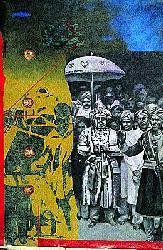
An artist's interpretation of Kirtimukha as a mascot of Hope: http://www.hinduonnet.com/folio/fo0104/01040380.htm )
|
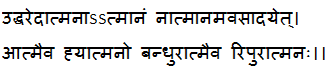 6-5
6-5